India is a land of extraordinary history, culture, and heritage. Across the country, magnificent forts, ancient temples, royal palaces, archaeological sites, caves, and monuments tell stories that have survived for centuries. For travelers who want to experience India’s past while discovering its diverse culture, exploring the historical places in India can be an unforgettable experience.
From the iconic Taj Mahal in Agra to the ancient ruins of Hampi, India’s historical attractions represent different kingdoms, empires, religions, architectural styles, and civilizations. Every destination has its own story, making a heritage journey across India both educational and exciting.
Whether you are a history enthusiast, photographer, family traveler, couple, or international visitor, India’s heritage destinations offer plenty to discover.
In this travel guide, let’s explore some of the best historical places in India that should be on every traveler’s bucket list.
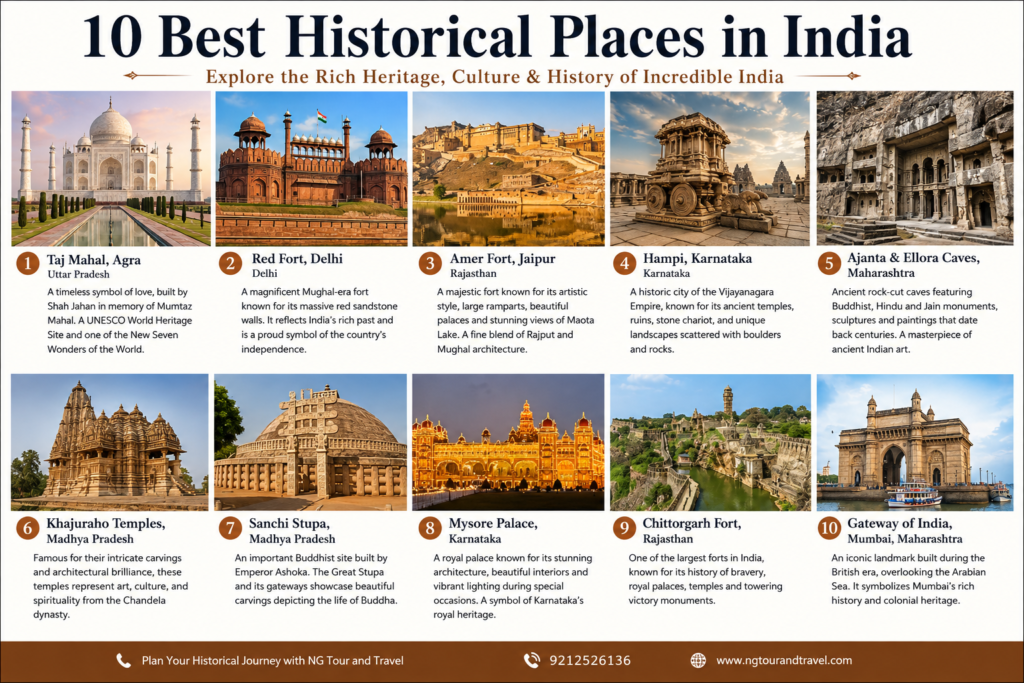
Why Explore Historical Places in India?
Traveling to historical destinations allows you to experience much more than beautiful buildings. These places provide a glimpse into India’s architecture, traditions, art, politics, religion, and lifestyle across different periods.
Historical monuments also help travelers understand how different civilizations and dynasties shaped modern India.
Here are some of the biggest reasons to explore India’s heritage destinations:
- Discover India’s fascinating history
- Experience unique architecture
- Learn about ancient civilizations and kingdoms
- Explore local traditions and culture
- Enjoy incredible photography opportunities
- Visit famous UNESCO World Heritage Sites
- Combine sightseeing with educational experiences
- Discover lesser-known stories behind famous monuments
Now, let’s explore some of the most remarkable historical destinations in India.
1. Taj Mahal, Agra
The Taj Mahal is undoubtedly one of the most famous historical places in India. Located in Agra, Uttar Pradesh, this magnificent monument is internationally recognized for its breathtaking architecture and historical significance.
Built during the Mughal era, the Taj Mahal was commissioned by Emperor Shah Jahan in memory of his wife Mumtaz Mahal. Constructed primarily from white marble, the monument features a magnificent central dome, elegant minarets, decorative gardens, and intricate craftsmanship.
The beauty of the Taj Mahal changes throughout the day. Early morning light creates a peaceful atmosphere, while sunset gives the monument a warm and dramatic appearance.
A trip to Agra can also include other important attractions such as Agra Fort and the historic areas surrounding the Taj Mahal.
Things to Experience in Agra
- Visit the Taj Mahal at sunrise
- Explore Agra Fort
- Photograph the monument and gardens
- Discover Mughal architecture
- Experience local food and handicrafts
The Taj Mahal is an ideal destination for couples, families, photographers, and international travelers.
2. Red Fort, Delhi
Located in the heart of India’s capital, the Red Fort is another iconic monument that reflects the grandeur of Mughal architecture.
The massive red sandstone fort was built during the reign of Shah Jahan and served as an important center of Mughal power. Its enormous walls, grand gateways, royal halls, gardens, and decorative structures showcase the architectural excellence of the era.
The monument also has a significant place in India’s modern history. Every year on Independence Day, India’s Prime Minister addresses the nation from the Red Fort.
Visitors can explore several important sections of the complex, including royal halls and historic gateways.
Delhi is particularly suitable for history lovers because the city contains monuments representing several different periods of Indian history.
3. Amer Fort, Jaipur
Rajasthan is famous for its royal heritage, and Amer Fort is one of its most impressive landmarks.
Located near Jaipur, Amer Fort stands on a hill overlooking the surrounding landscape. Built using sandstone and marble, the fort combines Rajput and Mughal architectural influences.
Inside the fort, visitors can explore beautiful courtyards, royal rooms, gardens, gateways, and decorated halls. The famous Sheesh Mahal is particularly admired for its intricate mirror decoration.
The fort’s elevated location also provides impressive views of the surrounding hills and historic landscape.
Why Visit Amer Fort?
Amer Fort is perfect for travelers interested in:
- Rajput history
- Royal architecture
- Photography
- Indian culture
- Historic forts
- Traditional Rajasthan
A Jaipur heritage trip can also include City Palace, Jantar Mantar, Hawa Mahal, and other attractions.
4. Hampi, Karnataka
Hampi is one of the most fascinating historical destinations in southern India.
Located in Karnataka, Hampi was once the capital of the powerful Vijayanagara Empire. Today, its enormous ruins are spread across a unique landscape filled with rocky hills, ancient temples, stone structures, and historic marketplaces.
Walking through Hampi feels like exploring an open-air archaeological museum. The combination of ancient architecture and dramatic natural scenery makes the destination particularly attractive to photographers and history lovers.
Some of the major attractions include Virupaksha Temple, Vittala Temple, the famous Stone Chariot, Lotus Mahal, Elephant Stables, and the Royal Enclosure.
Hampi is also an excellent destination for travelers who want to experience a quieter and less conventional side of India’s history.
5. Ajanta and Ellora Caves, Maharashtra
The Ajanta and Ellora Caves are among the finest examples of ancient rock-cut architecture in India.
Located in Maharashtra, these remarkable cave complexes contain temples, monasteries, sculptures, paintings, and artistic details carved directly into rock.
Ajanta is especially famous for its Buddhist paintings and sculptures, while Ellora represents Buddhist, Hindu, and Jain traditions.
The craftsmanship found throughout the caves demonstrates the remarkable skills of ancient Indian artists and builders.
Highlights of Ajanta and Ellora
- Ancient Buddhist caves
- Rock-cut temples
- Historic paintings
- Detailed sculptures
- Hindu and Jain monuments
- Ancient architectural techniques
For anyone interested in ancient Indian history, art, architecture, and culture, Ajanta and Ellora are must-visit destinations.
6. Khajuraho, Madhya Pradesh
The Khajuraho Group of Monuments is one of India’s most extraordinary examples of medieval temple architecture.
Located in Madhya Pradesh, Khajuraho is famous for its beautifully carved sandstone temples. The walls contain thousands of intricate sculptures representing religious themes, musicians, dancers, animals, everyday life, and different aspects of human existence.
The temples were constructed during the Chandela period and demonstrate an extraordinary level of artistic craftsmanship.
Khajuraho is an excellent destination for travelers who appreciate architecture and sculpture.
Why Khajuraho Should Be on Your Travel List
- Incredible stone carvings
- Historic temples
- Medieval Indian architecture
- Cultural significance
- Photography opportunities
- Fascinating historical stories
The destination provides a unique opportunity to appreciate India’s artistic heritage.
7. Sanchi Stupa, Madhya Pradesh
Sanchi is one of India’s most important Buddhist heritage destinations.
The Great Stupa at Sanchi is associated with Emperor Ashoka and is one of the most recognizable ancient Buddhist monuments in the country.
The site contains stupas, monasteries, pillars, temples, and beautifully carved gateways. The carvings on the gateways depict stories, symbols, people, animals, and scenes connected with Buddhist traditions.
Sanchi offers a peaceful atmosphere and is ideal for travelers who enjoy history, archaeology, architecture, and cultural tourism.
Visitors can spend several hours exploring the archaeological complex and learning about the development of Buddhism in ancient India.
8. Mysore Palace, Karnataka
Mysore Palace is one of the most impressive royal buildings in India.
Located in Mysuru, Karnataka, the palace represents the grandeur of the Wadiyar royal family and is admired for its elaborate architecture and beautifully decorated interiors.
The palace combines several architectural influences and contains grand halls, courtyards, decorative ceilings, artwork, and colorful glass details.
One of the most spectacular experiences is seeing the palace illuminated during special occasions.
Mysuru itself is also known for its cultural traditions, local cuisine, handicrafts, silk, and sandalwood products.
A visit to Mysore Palace allows travelers to experience both the architectural beauty and cultural heritage of Karnataka.
9. Chittorgarh Fort, Rajasthan
Chittorgarh Fort is one of Rajasthan’s most historically significant forts.
The massive hilltop fort is closely associated with the history of Mewar and the Rajput kingdoms. It contains palaces, temples, towers, gateways, reservoirs, and other historical structures.
The fort is famous for stories of bravery, battles, sacrifice, and Rajput resistance.
Important attractions within the complex include Vijay Stambh, Kirti Stambh, Rana Kumbha Palace, and Padmini Palace.
Exploring Chittorgarh provides travelers with a deeper understanding of Rajasthan’s royal history and the importance of forts in medieval India.
For travelers interested in historical monuments in India, Chittorgarh is a destination worth adding to a Rajasthan itinerary.
10. Gateway of India, Mumbai
The Gateway of India is one of Mumbai’s most recognizable landmarks.
Located beside the Arabian Sea, this historic monument represents an important chapter in India’s colonial-era history. Its architecture features Indo-Saracenic influences and has become an important symbol of Mumbai.
Today, the Gateway of India is surrounded by a lively atmosphere and is one of the city’s most popular tourist attractions.
Visitors can enjoy views of the waterfront, explore nearby heritage areas, and combine their visit with other Mumbai attractions.
The monument is particularly beautiful during the evening when the surrounding area becomes lively with visitors and photographers.
Other Historical Places in India Worth Exploring
India has far more historical attractions than can be covered in a single list.
Travelers who want to explore beyond the destinations mentioned above can consider:
Mehrangarh Fort, Jodhpur
One of Rajasthan’s most impressive forts, Mehrangarh rises above Jodhpur and offers spectacular views of the Blue City.
Fatehpur Sikri, Uttar Pradesh
This historic city near Agra contains impressive Mughal-era architecture and is an excellent addition to a Golden Triangle itinerary.
Konark Sun Temple, Odisha
The temple is famous for its remarkable architecture and its design inspired by a giant chariot.
Mahabalipuram, Tamil Nadu
Mahabalipuram is known for its ancient temples, rock-cut monuments, sculptures, and coastal heritage.
Golconda Fort, Hyderabad
This enormous fort provides an insight into the history of the Deccan region and is known for its impressive architecture and engineering.
Best Historical Tours in India
One of the easiest ways to explore India’s heritage is by creating a destination-based itinerary.
Delhi – Agra – Jaipur
This is one of India’s most popular heritage routes.
A typical journey can include:
Delhi → Agra → Jaipur
Travelers can explore the Red Fort, India Gate, Humayun’s Tomb, Taj Mahal, Agra Fort, Amer Fort, City Palace, and other attractions.
Rajasthan Heritage Tour
A longer Rajasthan itinerary can include:
Jaipur → Jodhpur → Udaipur → Chittorgarh
This route combines magnificent forts, royal palaces, lakes, local markets, and traditional Rajasthani culture.
Karnataka Heritage Tour
Travelers interested in South Indian history can combine:
Mysuru → Hampi → Badami → Pattadakal
This route provides a fascinating combination of royal heritage, ancient temples, and archaeological sites.
Best Time to Visit Historical Places in India
The best time to explore many historical destinations depends on their location.
For most popular destinations in North and Central India, the period between October and March is generally comfortable for sightseeing.
Summer can be hot in several parts of India, so travelers should plan outdoor sightseeing carefully and stay hydrated.
If you are visiting South India, weather conditions can vary by region, so checking the destination’s seasonal climate before traveling is recommended.
Always check monument opening hours, local holidays, ticket requirements, and current visitor rules before starting your trip.
Travel Tips for Visiting Historical Monuments
A little preparation can make your heritage journey much more comfortable.
Start Early
Popular attractions can become crowded later in the day. Morning visits can provide a more relaxed experience.
Wear Comfortable Shoes
Large forts and archaeological sites often require significant walking.
Carry Water
Keep yourself hydrated, especially when visiting monuments during warmer months.
Follow Heritage Rules
Avoid touching sculptures, climbing restricted structures, or damaging historic surfaces.
Hire a Guide
A professional local guide can explain the stories and historical importance behind different structures.
Keep Your Camera Ready
Historical monuments provide excellent opportunities for travel photography.
Respect Local Culture
Many historical places are also religious or culturally important sites. Dress respectfully and follow local customs.
Why Historical Travel Is Important
Historical tourism plays an important role in preserving cultural heritage and helping future generations understand the past.
When travelers visit monuments responsibly, they contribute to the tourism ecosystem surrounding these destinations. Local guides, hotels, restaurants, transportation providers, artisans, and small businesses can all benefit from heritage tourism.
More importantly, historical travel encourages people to appreciate and protect India’s architectural and cultural legacy.
A monument is not simply an old structure. It can represent the achievements, struggles, traditions, creativity, and identity of generations of people.
Plan Your Historical Trip with NG Tour and Travel
Exploring the historical places in India can become much easier with proper planning.
From transportation and accommodation to sightseeing and itinerary planning, a reliable travel partner can help you organize a comfortable journey.
NG Tour and Travel offers travel assistance for people looking to explore destinations across India. Whether you are planning a family holiday, couple’s trip, heritage tour, sightseeing journey, or customized India vacation, a personalized itinerary can help you make better use of your time.
Instead of trying to manage every part of the journey yourself, you can plan your transportation, sightseeing, accommodation, and travel schedule according to your requirements.
For customized travel planning and assistance:
NG Tour and Travel
Phone: 9212526136
Start planning your next Indian heritage adventure and discover the stories hidden within India’s incredible historical destinations.
Frequently Asked Questions
What are the best historical places in India?
Some of the best historical places in India include the Taj Mahal, Red Fort, Amer Fort, Hampi, Ajanta and Ellora Caves, Khajuraho, Sanchi, Mysore Palace, Chittorgarh Fort, and Gateway of India.
Which historical place is most famous in India?
The Taj Mahal is arguably India’s most internationally famous historical monument. It is renowned for its Mughal architecture, white marble design, and historical association with Shah Jahan and Mumtaz Mahal.
Which Indian city is best for history lovers?
Delhi, Agra, Jaipur, and several cities in Rajasthan are excellent choices for history lovers. They contain numerous forts, monuments, palaces, museums, and heritage sites.
What is the best time to visit historical places in India?
For many destinations in North and Central India, October to March is a comfortable period for sightseeing. However, the ideal time varies depending on the destination.
Are historical places in India good for family trips?
Yes. Historical destinations can be excellent family attractions because they combine sightseeing, education, architecture, culture, and photography.
How many days are required for a historical tour of India?
The duration depends on the route. A Delhi-Agra-Jaipur heritage tour can typically be planned for around 5–7 days, while exploring several regions of India may require two weeks or more.
Conclusion
India’s historical heritage is a remarkable reflection of its diverse civilizations, kingdoms, cultures, religions, and artistic traditions. From the timeless beauty of the Taj Mahal to the ancient ruins of Hampi, every destination offers a different story.
Exploring the historical places in India gives travelers an opportunity to see magnificent architecture while learning about the people and civilizations that shaped the country.
Whether you are planning a short heritage holiday or a long journey across India, there is always another fort, palace, temple, cave, or ancient city waiting to be discovered.
So, pack your bags, choose your destination, and begin your journey through India’s incredible history with NG Tour and Travel.